





Fintech
Move faster on compliance-heavy work without losing the audit trail.
Thundrom designs and builds custom AI — assistants, agents and AI features for your existing products — tested against real data and ready for real users.
Products we've designed, built and shipped
Plenty of AI pilots impress in a meeting and then quietly stall. We plan for the hard parts from day one — evaluation, permissions, monitoring and cost — so what we build keeps working after launch.
A start-up validating an idea needs something different from an enterprise rolling AI out across teams. We match the scope, architecture and engagement to where you are now, and make sure it can grow.

From the first workshop to the system your customers use every day — choose a service to see what it covers.
When an off-the-shelf tool does not fit the way your business actually works, we design and build the AI product around your workflow — from a narrow internal tool to a customer-facing feature.
Every build starts from a measurable goal, ships with an evaluation set, and is designed so the underlying model can be swapped as better options appear.
Agents that read, decide and act across your tools: triaging requests, preparing documents, updating records and handing anything uncertain to a person.
We design permissions, approval steps and audit trails first, so automation stays safe once it is connected to real systems.
Support and internal assistants grounded in your own documents through retrieval-augmented generation, so answers come with sources instead of guesses.
Conversations that need a human are handed over with full context, and every exchange can be reviewed to keep improving answers.
Most of the value sits inside software you already run. We add search, summarisation, classification, extraction or drafting to existing web and mobile apps through clean APIs — no rewrite required.
Integrations respect your existing permissions, data residency and release process.
Launch is where real usage starts. We monitor answer quality, latency, cost and drift in production and keep improving the system on real data.
When models, prices or regulations change, we update the stack with you rather than leaving you with a frozen prototype.
Nobody needs "a model". They need a queue cleared, a process sped up or a customer helped faster. These are the problems we are most often asked to solve — and what we build for each.
Is AI the right tool? Read our guide →The problem: Customers wait longer while agents answer the same questions again and again.
What we build: An assistant grounded in your help content that resolves routine questions and routes the rest — with the conversation so far — to the right person.
Agents spend their time on the requests that genuinely need them.
The problem: Invoices, contracts, forms and reports are read, checked and re-typed manually.
What we build: Document intelligence that extracts the fields you need, validates them against your rules and flags exceptions for review.
Faster processing with a person reviewing only what the system is unsure about.
The problem: Keyword search misses what people mean, so they leave without finding it.
What we build: Semantic search and recommendations that understand intent across your catalogue or knowledge base.
More relevant results for the way customers actually describe what they need.
The problem: Teams waste time hunting through drives, wikis and chat history for answers.
What we build: An internal knowledge assistant that answers from approved sources, cites them and respects existing access rights.
New and existing staff get trustworthy answers without interrupting colleagues.
The problem: The same sequence of checks, updates and messages is done by hand every day.
What we build: An agent that runs the routine steps across your tools, asks for approval where it matters and logs every action.
Processes that run consistently, with a full audit trail.
Where AI pays off first in the industries we serve, and what we typically build for each.
Move faster on compliance-heavy work without losing the audit trail.
Cut administrative load while clinicians stay in control of every decision.
Personalised learning support that scales with your learners, not your headcount.
Help shoppers find the right product the way they actually describe it.
Keep shipments moving by catching exceptions before they turn into delays.
Put company knowledge to work inside the tools and permissions you already have.
We stay model-agnostic and pick each component for quality, speed, cost and privacy needs.
Product names are trademarks of their respective owners.
Six stages, each with a clear output, so you always know what you are paying for.
Agree the problem, the users and a success metric worth paying for.
Check what data exists, its quality and the rules around using it.
Build a working prototype and test it against a real evaluation set.
Add integrations, permissions, guardrails, tracing and cost controls.
Release in stages, with people reviewing outputs where risk is high.
Monitor quality, cost and drift, and iterate on real usage.
Best when the use case is clear
Best for ongoing or evolving AI work
Best before committing to a build
It depends on what you are building. Most projects fall into one of three shapes — each is scoped and quoted individually once we understand your use case.
Answers one question: can AI solve this well enough with your data? A focused prototype tested against real examples.
Suits: Unproven ideas and internal buy-in
A first real release for actual users, with integrations, guardrails, monitoring and an evaluation suite.
Suits: Validated use cases ready for users
Multiple use cases, agents or teams sharing one governed platform with shared tooling and controls.
Suits: Organisations rolling AI out widely
A single-purpose assistant is far simpler than agents acting across many systems.
Clean, accessible data shortens the build; scattered data adds preparation work.
Every system the AI reads from or writes to adds design, security and testing.
Regulated data needs extra controls: access policies, logging and human review.
Model usage, hosting and monitoring continue after launch and belong in the budget.
The right partner is the one whose work is still running a year later. Six questions worth asking any AI development company — including us.
Why AI projects fail in production →Ask how quality will be measured and what happens when the model is wrong.
Prototypes are easy. Look for systems that real users rely on.
Your product should not depend on a single vendor's pricing or roadmap.
Permissions, data handling, approvals and audit logs should come up unprompted.
Know whether senior engineers own the work or it is passed down the chain.
Monitoring, cost control and model upgrades decide long-term value.
The people who scope your project are the people who build it.
We choose models per use case and keep them swappable.
Every release is tested against a real evaluation set before it ships.
Least-privilege access, approvals and audit trails are part of the design.
Our apps are live on Google Play, so we build like product owners.
One team can take an AI feature all the way into your web and mobile apps.
Real products, live today.
Our own document app that turns paper into searchable PDFs with text extraction, live on Google Play.
View our apps →
On-device scanning with multi-layer link-safety checks that warn users before they open a risky link.
View our apps →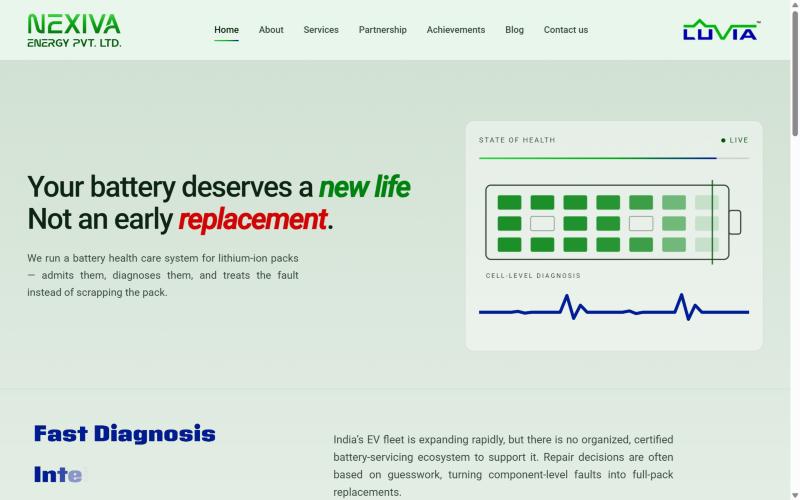
A website we designed and built for Nexiva Energy Pvt. Ltd., a diagnosis-led EV battery service company in India.
See the project →Answers to what teams usually ask before starting an AI project with us.
Ask us anythingA focused prototype typically takes a few weeks. A production system takes longer, depending on integrations, data readiness and compliance needs — we agree milestones after a short discovery phase.
Not always. Many assistants work from your existing documents through retrieval, without training a model. Predictive models do need representative historical data; discovery tells you which case you are in.
We choose per use case, weighing quality, latency, cost and privacy requirements, and design the system so the model can be replaced later without a rebuild.
Least-privilege access to tools and data, human approval for high-impact actions, evaluation sets that run before every release, and production tracing so every answer and action can be reviewed.
Yes. Much of our AI work extends web, mobile and internal products teams already run, through APIs, rather than replacing them.
Yes. We can deliver end to end, embed engineers with your team, or start with a discovery sprint and hand over a clear plan.
Tell us what you want to automate or build. We respond within 24 hours and will help you choose the right first project.